Arrow pointing to button
Untitled design (8)
SHARPSCYCLE LOGO
Restroom Sharps Collection Program

The needle’s already in the building.

Every day, people use your restroom to inject insulin, GLP-1s, and other prescribed medications. Without a designated disposal option, used needles end up in the trash or on the floor. And when your custodian or a customer gets stuck, the claim lands on your business, not on whoever left the needle behind.

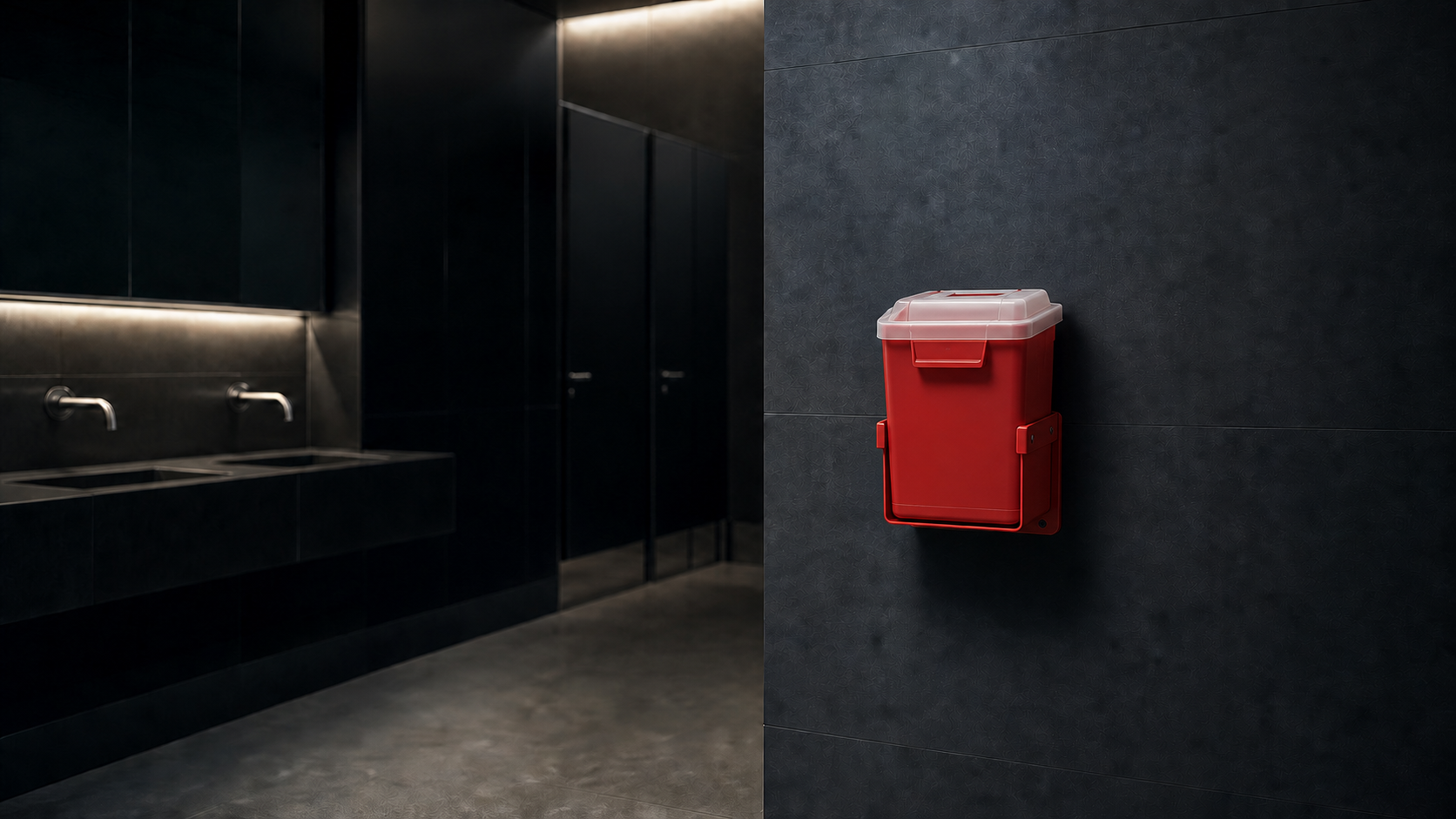
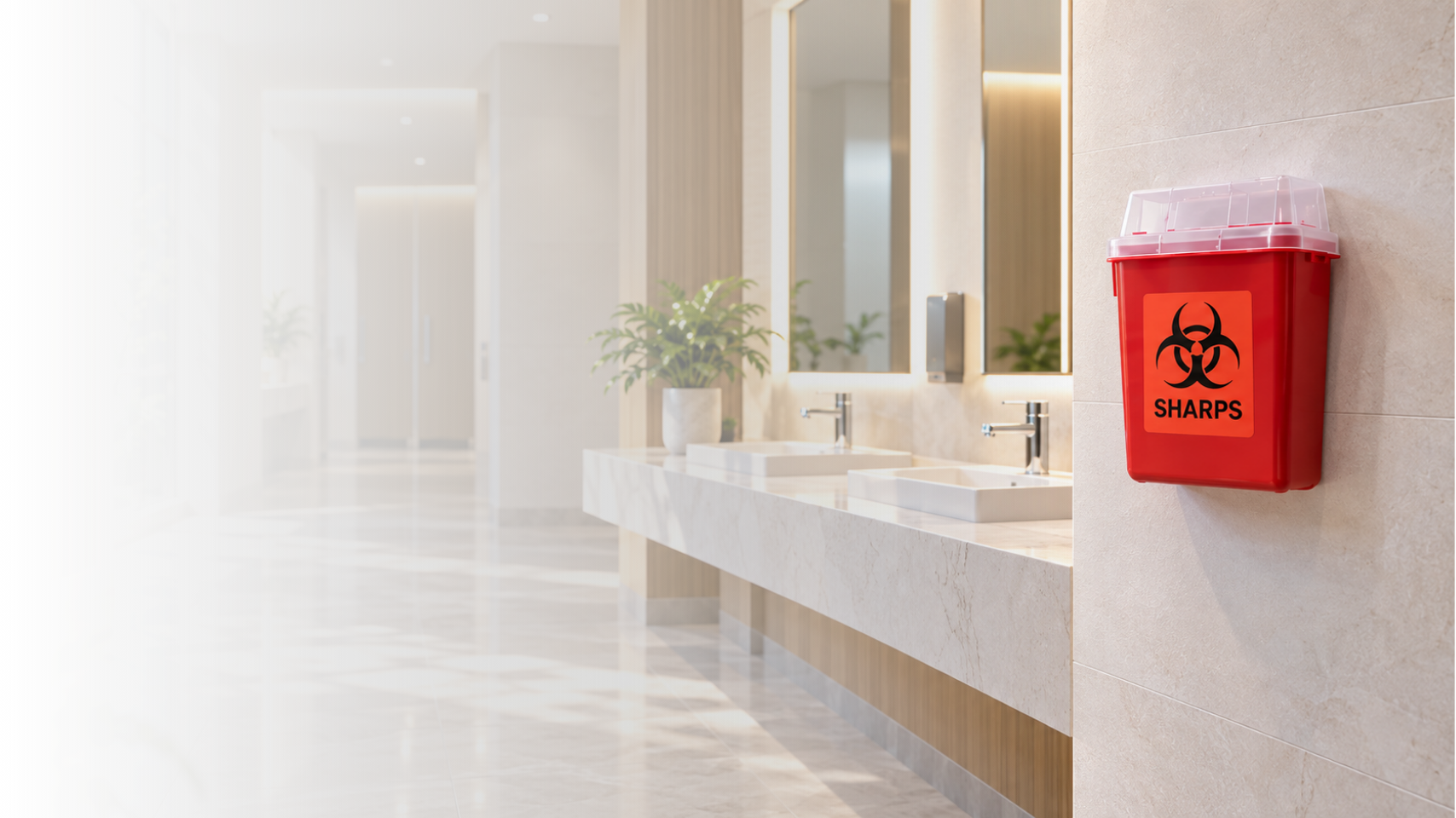
  • Locking wall-mounted containers
  • Scheduled collection
  • Trained technicians
  • Proof of completion
The problem

 Somebody has to carry the bag out. 

An estimated 15% of U.S. adults use an injectable medication, in a building of 50 people, that’s roughly 7–8 of them.

Gallup: ~11% on GLP-1s alone; insulin and other injectables bring it to ~15%.

  1. Someone Uses an Injectable Medication
  2. The Needle Goes in the Trash
  3. Your Custodian Carries the Bag Out

A simple disposal option can prevent the needle from entering the regular waste stream.

A single stick from a discarded needle can start months of blood tests and preventive medication. OSHA names hepatitis B, hepatitis C and HIV as the risks, and HIV still has no cure.


Why this matters
How it works

A container on the wall isn't a program.

The same process behind every service we run.
Three steps to set it up, then a service that never stops.

  1. Consult

    We look at your facility, how many restrooms need coverage, and the expected volume.

  2. Design

    We set container placement and a service frequency that fits the building.

  3. Implement

    We install locking, wall-mounted sharps containers in the restrooms you designate.

  4. Service in Motion

    The sharps container is filled. Trained technicians handle every swap, manifest the waste, transport and destroy it, and send proof of completion. Then it repeats.

Sheredder_icononly
Free assessment

Tell us about your building.

  • Free, no-obligation assessment
  • Priced per restroom, installation included
  • A real person reviews it, not a bot

We size the program to your facility, then send you a plan and a price.
No cost, and no obligation.

Free assessment, no obligation
Request a free assessment

855-99-SHRED

the-shredder.com/restroom-sharps-disposal

Call us, or request your assessment online. It is free, and it carries no obligation.

Why it matters

The question is not whether you need a container. It is who empties it.

Regulatory position

OSHA recommends it. The trash was never the alternative.

The federal standard does not reach a typical office. It still names the risk, and it still asks employers to act.

OSHA recommended

 OSHA's Bloodborne Pathogens Standard covers workers exposed to blood on the job, not a person injecting their own medication in a typical office. But it still names discarded needles as a hazard to the workers who handle the trash later, and recommends employers require special containers. The moment one of them is stuck, the exposure is occupational and the standard applies. 

Loose Sharps in the bin is not an option

State agencies set the rules here, not OSHA. Not one approves a loose needle in the trash. Every approved path starts with a rigid, lidded, labeled container. Where it goes next is a state-by-state question. Whether you need one isn't. And the home-use exception those rules rely on was never written for a business.

People can ask for it

Under the ADA, a person managing a condition like diabetes can request a reasonable accommodation from an employer of 15 or more. The EEOC's own guidance includes a private place to self-administer medication. Having a disposal option already in place means no one has to raise or explain a medical condition to get one. 
ChatGPT Image Sep 23, 2026, 09_53_26 AM
Who empties it

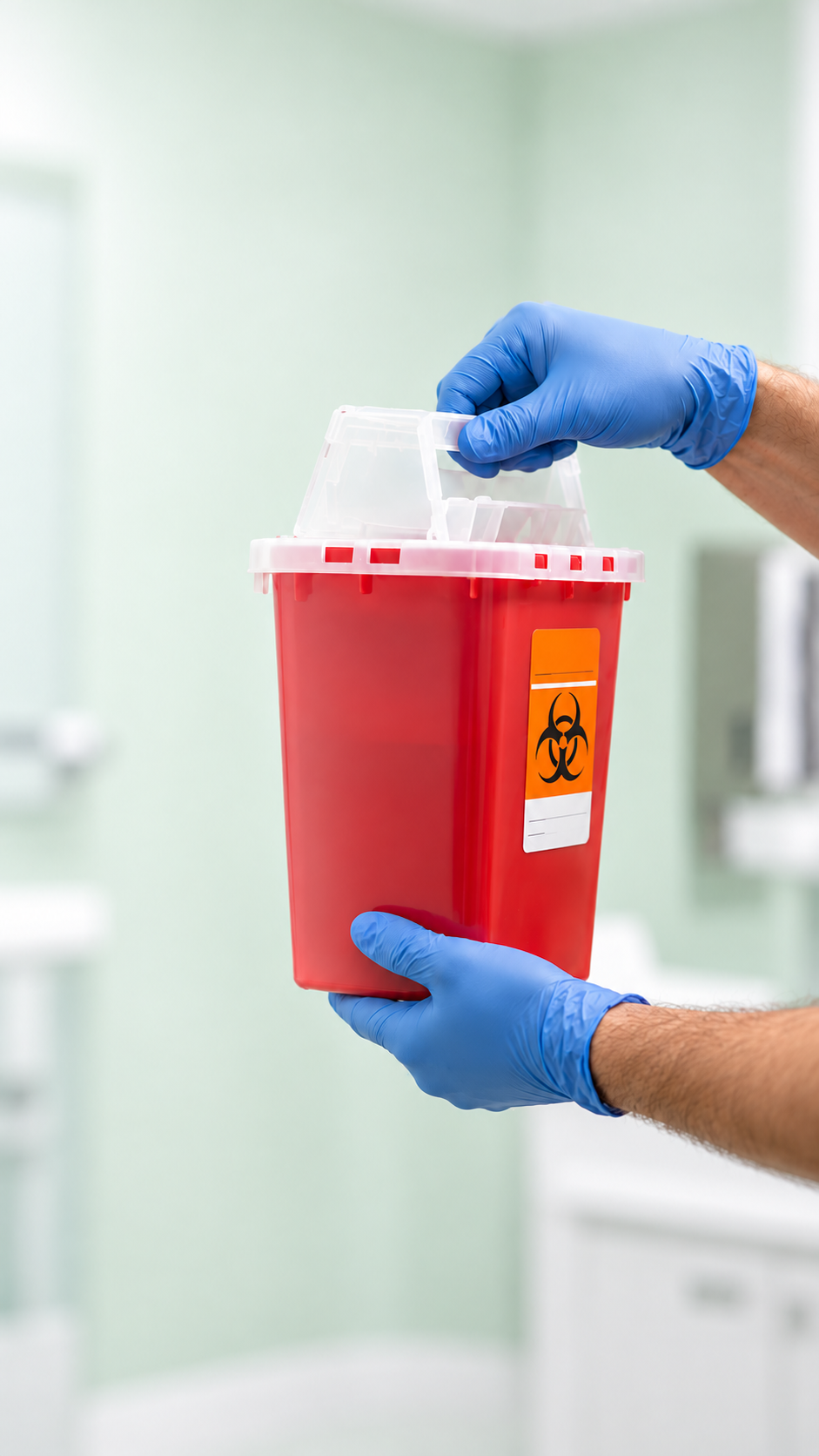
Your staff never has to handle it

  • No training for OSHA's
    bloodborne pathogens
  • No training for federal
    DOT packaging requirements
  • No packaging
  • No shipping
  • No fill-level management

Scheduled service. Documented collection. You get the paperwork, not the liability.

The source

Don't take our word for it. Read OSHA's.

Three passages from one letter, quoted exactly as written.

Does not apply

The Bloodborne Pathogens Standard, 29 CFR 1910.1030, does not apply to the self-administration of insulin by a person or their disposal of insulin syringes used for self-administration except at places otherwise covered by the standard, such as health care facilities, industrial first aid units, and laboratories.

And in the same letter

Improper disposal of insulin needles however, can create a safety hazard for maintenance workers, waste handlers, and janitors who must later handle the office trash placing them at risk for exposures to bloodborne pathogens including HIV/AIDS, hepatitis B, and hepatitis C from needlestick injuries.

And what OSHA requires

Therefore, OSHA recommends to require insulin-using people to discard their used syringes in special containers rather than allowing them to be discarded in regular office trash.

OSHA Standard Interpretation, 29 June 2007. Quoted unedited, so you can check it.

  • OSHA compliant
  • DOT-compliant transport
  • OSHA-compliant destruction
  • Nationwide service

What About Home Sharps Containers?

OSHA’s letter goes on to say that home-use sharps containers would work. That’s true.

But a container sitting on the counter still raises the same three questions:

Who empties it?
Where does it go?
How do you prove it was handled correctly?

A container on the wall isn't a program. Scheduled service and documented records are.

Fifty states. Fifty agencies. Fifty different rulebooks. Guidance varies state to state, but the direction is consistent: a rigid, lidded, labeled container, not loose disposal. 

Further clarification on the difference between OSHA and the 50 agencies:

Two agencies, two different questions. OSHA governs worker exposure and its own standard doesn't reach a person injecting their own medication, which is why its letter recommends a container rather than requiring one. State environmental and health agencies govern the waste itself: how sharps have to be contained, transported, and destroyed. Neither one gives the business a pass. And once a needle is in the trash and someone on your cleaning crew handles it, you're back in OSHA's jurisdiction.

Who we serve

Trusted by businesses of all types.

  • Offices
  • Banks
  • Schools
  • Gyms
  • Hotels
  • Warehouses
  • Public buildings

The program fits any building with restrooms and people.

What it costs

It bills like the coffee service, not like a compliance project.

  • Simple monthly or annual subscription
  • Priced per restroom
  • Most offices need service only twice per year
  • We assess your facility and recommend the right plan
coffee+sharps_container
The outcome

What you get

  • Safe, compliant sharps disposal
  • Lower workplace risk
  • Documentation for peace of mind
  • One dependable local partner
Get a quote

Put a locking sharps container on your restroom wall

Sign up online and we handle the rest: installation, scheduled collection, destruction and proof of completion. Your staff never touches a needle.

Give the needle somewhere to go.

Installation included

Priced per restroom

Takes about 5minutes to sign up

FAQs

Questions facilities managers ask.

It’s the right question, and the answer depends on which agency you’re asking. Here’s how the authority divides up.

  • OSHA covers exposure on the job. Its Bloodborne Pathogens Standard (29 C.F.R. § 1910.1030) doesn’t reach a person injecting their own medication in a typical office. But OSHA has said improper disposal creates a hazard for janitors, maintenance workers, and waste handlers, and recommends people to use special containers instead of regular trash (OSHA Standard Interpretation, June 29, 2007). For most offices, that’s a recommendation, not a requirement. Where staff can reasonably expect to encounter needles as part of their job, such as janitorial staff expected to pick up loose needles, the standard requires compliant sharps containers (§ 1910.1030(d)(4)(iii)(A)) and bloodborne pathogens training.
  • State agencies control the waste. Not OSHA, not the federal EPA. Each state sets its own rules through agencies that don’t even share a name: the DNR in Iowa, IEPA in Illinois, the Pollution Control Agency in Minnesota. Requirements vary. State agencies across our region tell people never to put loose needles in the trash, and Wisconsin goes further and prohibits sharps in the trash by law (Wis. Admin. Code ch. NR 526).
  • The ADA adds a third angle. Companies with 15 or more people are covered by Title I of the ADA (42 U.S.C. § 12111(5)). A company faced with a disability-related request to test or administer medication at work may also need to address any workplace barrier to safe sharps disposal (42 U.S.C. § 12112(b)(5)(A)). The Department of Labor-funded Job Accommodation Network identifies a designated sharps container as a possible accommodation for people with diabetes. Making a restroom program available for general use gives everyone a safe disposal option without requiring a person to disclose a medical condition to use it.
  • The gap is where your business sits. Those state rules were written mainly for two groups: residents handling sharps at home, and medical waste generators like clinics and labs. An office, a gym, or a warehouse is often neither. That isn’t an exemption; it means no one has told you what your obligation is. If someone is injured, the question is likely to be whether you took reasonable steps given a risk you knew about.

For about the price of a specialty coffee per restroom each month, the program gives you a proper disposal path, your staff never open, remove, package, label, or ship a sharps container, and you hold the documentation showing it.

Most offices need service twice per year. The assessment sets the schedule from your headcount, restroom count and building type, so you are not paying for visits you don't need. If usage changes, we change the schedule.

We do. A trained technician swaps the sharps container on site. Your staff never packages, ships, or checks fill levels, and never opens a container. You receive full documentation of the cradle-to-grave manifest tracking for your records.

Wall-mounted inside the restroom, positioned for reach and for privacy. The units lock, so contents cannot be retrieved. We confirm placement with your facilities team during installation.

The assessment is free. Pricing is a simple monthly or annual subscription priced per restroom, with installation included. You get the number before you commit to anything.

The claim goes to whoever controlled the space. Not whoever left the needle, a customer, a visitor, someone who wandered in off the street. In most of these cases nobody ever identifies who left it. That doesn't help the business, because the question isn't who dropped the needle. It's who was responsible for the room.

The pattern in these cases is consistent, and it isn't about whether a needle was present. Needles turn up. That's why we say the needle is already in the building. What these cases turn on is whether the business had a system.

A customer at a national retailer was punctured by a syringe her child picked up on the property. A jury found the retailer negligent and the state supreme court let the liability finding stand. The store's own manager testified there was no formal policy for inspecting the area where the needle was found.

A contracted cleaning worker stuck by a needle in an office waste container sued the tenant rather than her own employer, alleging the company had been discarding used needles in ordinary waste containers. The court declined to dismiss the case or grant summary judgment.
When two workers at a single retail location were stuck, the state OSHA penalty included a line item for not providing sharps containers in areas where sharps were commonly found.

None of these turned on a rule requiring a sharps container. They turned on foreseeability, whether the business knew this could happen and whether it had done anything about it. A locked container on the wall and a documented service record answer that question before it's asked.

A person holding a small glass medication vial and reading its label.
From our blog

Where Should People Throw Away Used Ozempic, Wegovy, or Mounjaro Needles?

The question behind this page, answered at length: why the needles started showing up, what the guidance actually says, and what a building can do about it.


Read the article

The needle is already in the building.

The only question is whether it has somewhere to go.

(855) 997-4733 OSHA & DOT compliant
Disclaimer: The information provided on this page is for general informational purposes only and does not constitute legal or regulatory compliance advice. Requirements may vary depending on the workplace, applicable regulations, and specific circumstances. Businesses should consult the appropriate regulatory authorities or qualified professionals to determine their compliance obligations.