Where Should Employees Throw Away Used Ozempic, Wegovy, or Mounjaro Needles?
Quick answer: Used GLP-1 pens and needles (Ozempic, Wegovy, Mounjaro, Zepbound) should never go in a regular trash can or restroom wastebasket. They belong in an FDA-cleared sharps container. If your workplace doesn't have one, the safest options are a personal sharps container you dispose of through a pharmacy take-back or mail-back program, or — if you're an employer reading this because your team keeps asking — a managed sharps disposal service that installs and services containers on-site.
That second part is the part almost nobody is prepared for right now.
A question that's suddenly everywhere
If you spend any time on Facebook or in local community groups, you've probably seen it: someone asking what they're supposed to do with a used Ozempic pen, or where the nearest sharps drop-off is. It's not a niche question anymore. Between GLP-1 medications for diabetes and weight management and the growing use of injectable peptides, more people than ever are self-administering injections at home — and now, increasingly, at work, during a lunch break or between meetings.
The medications get all the attention. The used needle that's left over doesn't. And that's created a quiet compliance gap that most offices haven't caught up to yet.
The employer's version of this question
Employees taking these medications don't stop needing a safe place to dispose of a needle just because they're at work instead of home. Which means HR departments and office managers are starting to field a version of the same question: "Is there somewhere I'm supposed to put this?"
If you're an employer, the real question isn't really about needles. It's this: Should I have a sharps disposal program in my office restrooms?
Here's the honest, experience-based answer, from a company that builds these programs for a living.
What OSHA actually requires — and what it doesn't
There's a lot of confusion here, so let's be precise. OSHA's Bloodborne Pathogens Standard (29 CFR 1910.1030) governs occupational exposure — situations where handling blood or sharps is part of the job, like healthcare, first aid, or lab work. It does not require a typical office, call center, or retail location to provide sharps containers for employees who are self-injecting insulin, GLP-1s, or peptides for personal health reasons.
OSHA has said as much directly. In a 2007 letter of interpretation, OSHA confirmed that "the Bloodborne Pathogens Standard does not apply to the self-administration of insulin by employees or their disposal of insulin syringes, except in places already covered by the standard, such as health care facilities, first aid units, and laboratories — meaning a typical office would not be covered." The same letter is explicit, though, that "improperly discarded needles create a real safety hazard for maintenance workers, waste handlers, and janitors who handle that trash afterward, putting them at risk of bloodborne pathogen exposure."
So: not legally mandated. Strongly, obviously advisable. That's the gap most companies are sitting in right now, usually without realizing it.
Does your state actually allow sharps in the trash?
OSHA is only half the picture. Sharps disposal is also governed at the state level, and this is where it gets genuinely inconsistent — every state handles it differently, and the guidance that does exist is almost always written for households, not offices.
Here's how it breaks down across the Midwest:
States that generally allow it, if properly contained:
- Iowa — Iowa DNR guidance confirms it's currently legal to place sharps in the garbage in a lidded, rigid container labeled "Do Not Recycle: Household Sharps," with sharps going in point-first.
- Missouri — Missouri DNR guidance says individuals generating infectious waste at home are largely exempt from the state's disposal requirements, so long as sharps are properly packaged before going in the household trash.
- Nebraska — Nebraska's Title 132 provides a household exemption allowing infectious waste, including sharps, to go in regular trash if placed in a rigid, puncture-resistant, leak-proof container.
- Illinois — Illinois EPA guidance exempts home-generated sharps from its Potentially Infectious Medical Waste law, and lists trash disposal (safely packaged) as an acceptable last-resort option behind drop-off and mail-back programs.
- Kansas — KDHE guidance is notably broader than most states: it's legal to dispose of sharps in a sealed, puncture-resistant, labeled container with household trash "generated at any location that is not a regulated health care provider" — language that explicitly extends beyond the household to community and workplace settings.
States with tighter restrictions:
- Minnesota — MPCA guidance allows a labeled, closed, taped sharps container in the regular trash, but only discourages it and treats it as a last resort behind collection sites and mail-back programs. Critically, MPCA states this guidance is "intended for households and individual citizens only" — health care providers and other businesses that may generate sharps are explicitly told they cannot rely on this household allowance.
- Wisconsin — Sharps have been banned from the trash and recycling entirely since 1994, for households and businesses alike. Wisconsin's DNR guidance goes a step further and speaks directly to this exact scenario: it states that if a business provides sharps boxes for guests or employees to use, that business is legally considered a "sharps generator" in its own right — not a passive household-rules bystander.
- California and Massachusetts ban household sharps disposal in the trash outright, statewide, with no "properly contained" exception at all.
The pattern that matters most: even in states that allow it, the guidance is written for households. Minnesota says so explicitly. Wisconsin goes further and says a business offering restroom sharps boxes becomes a generator with its own obligations, not a household. None of the states above have published guidance that squarely answers "can my office let employees toss sharps in the restroom trash?" — because the rules were never written with a corporate restroom in mind. That's not a loophole in your favor; it's a gap nobody has closed yet, and it's exactly the kind of ambiguity that turns into a liability question the day a janitor gets hurt.
This isn't legal advice, and state guidance changes — if you want a definitive answer for your specific location, confirm current rules with your state's environmental or health agency, or run it by counsel.
When "not mandated" becomes a real problem
This is where theory turns into liability. A capped needle in an office wastebasket doesn't stay capped or contained once it's bagged, compacted, and handled by someone else down the line.
That's not hypothetical. In one documented incident at UC Berkeley, a refuse and recycling employee was stuck by a needle while emptying trash from a dumpster. When staff investigated, they found the bag contained regular trash mixed in with lab materials — glass pipettes, Petri dishes, and syringes with unsheathed needles attached. The employee had to be treated immediately for possible HIV exposure. That case involved a lab, but the mechanism is identical to any office: once a needle enters a mixed trash stream, whoever handles that bag next — a janitor, a waste hauler, a recycling worker — inherits the risk, with none of the context or training to know it's coming.
That's the scenario that turns a "personal medical choice" into an employer's OSHA and workers' comp problem overnight. It also raises an ADA angle worth knowing: conditions like diabetes can qualify as disabilities, and providing a compliant, low-cost disposal option is the kind of reasonable accommodation employers are encouraged to consider — not because a regulator will show up and demand it, but because it's the easy, obvious right call.
Where this is already common — and what's broken about it
Sharps disposal programs aren't new. They've existed in gas stations, truck stops, gyms, and hotels for years, mostly for the same reason: public and semi-public restrooms see needle disposal whether the business planned for it or not.
But most of those existing programs have a structural flaw: they're unmanaged. The business installs a sharps container, and then leaves it up to whichever cleaning or maintenance staff happen to be on shift to notice when it's full, request a replacement, and mail the full container back to a disposal processor themselves. In practice, that means front-line staff — who typically have zero bloodborne pathogen training and zero familiarity with DOT hazardous materials packaging and transportation rules — are the ones responsible for handling and shipping medical waste. Most of the time, that training simply isn't happening, and the business has no idea it's exposed.
A managed program removes that gap entirely. Instead of relying on untrained staff to self-manage the process, a certified provider installs the containers, monitors and swaps them on a set schedule, and handles all packaging, transport, and destruction under proper regulatory chain-of-custody — with documentation to prove it. The business gets the benefit without absorbing the training burden or the risk.
The mistake we see most often
The single biggest mistake companies make is treating this as a one-time purchase instead of an ongoing program. Someone buys a small sharps container off a supply site, sticks it in a bathroom, and considers the problem solved. Nobody owns checking it. Nobody's tracking fill levels. Eventually it's overflowing, and now an employee is standing there thinking, "well, it's full — I'll just throw this one in the trash." That single moment is exactly the risk this is all meant to prevent, and it happens because there was never a real system behind the container in the first place — just an object.
Why offices haven't caught up yet
Frankly, it's an afterthought. Most companies aren't proactive about this because the need hasn't been visible to them — GLP-1 and peptide use has grown fast, and the disposal side of that hasn't kept pace in most workplaces' planning. The typical pattern is that nothing changes until a janitorial or maintenance employee is accidentally stuck by an uncapped needle. That's usually the first time it becomes a priority — reactively, after the fact, instead of proactively, before it happens.
What a real program looks like
At The Shredder + MedShred, a sharps program for a non-medical office follows the same four-step process we use for every service we provide:
- Consult — We look at your facility, how many restrooms need coverage, and expected volume.
- Design — We determine container placement and a service frequency that fits your facility (most offices land on twice a year; higher-traffic or larger facilities can go more frequently).
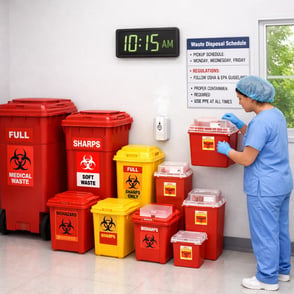
- Implement — We install wall-mounted, locking sharps containers in the restrooms you designate.
- Service in Motion — Our certified, trained technicians handle every swap, manifest the waste, and transport and destroy it properly — with proof of completion, so you're never guessing whether it happened.
Because it's billed as a simple monthly or annual subscription — priced per restroom — it tends to land in that same low-friction budget category as things like office water delivery or the coffee service: a small, predictable line item nobody thinks twice about, instead of a compliance project someone has to manage.
The bottom line
If your office has even one employee using GLP-1s, insulin, or injectable peptides — and statistically, most workplaces now do — the question isn't really whether you have to have a sharps program. OSHA won't force your hand here. The real question is whether you want to be proactive about a known, growing risk, or wait until a janitor gets stuck by a needle in a trash bag and finds out the hard way that your office wasn't ready.
A managed sharps program takes the entire burden off your team: no bloodborne pathogen training to arrange, no DOT packaging rules to learn, no manifest tracking to maintain, and no overflowing container turning into someone's bad day. We design it, install it, service it, and document it — so your only job is designating which restrooms need one.
Ready to find out what a sharps program would look like for your facility? Contact The Shredder + MedShred for a consult — most offices are surprised how simple and inexpensive it is to close this gap. Its as easy as calling us at 855-99-SHRED (515-280-3013 or 816-218-1188).




Comments