What Types of Medical Waste Can't Go in Regular Trash?
A Practical Guide for Nurses and Healthcare Professionals
By The Shredder + MedShred | 16+ Years | 8,000+ Customers
The Trash Can Is Not a Gray Area
If you have spent any time in a clinical setting, you already know that not all waste is created equal. But knowing that and consistently acting on it are two very different things. After 16+ years of providing regulated medical waste disposal services to more than 8,000 healthcare customers, we at The Shredder + MedShred have seen it all — and the most dangerous mistakes are rarely the dramatic ones.
They are the small, routine ones. The broken vial tossed in the trash. The needle set down "just for a moment." The expired medication flushed down the sink. These are the habits that injure staff, expose facilities to six-figure fines, and create public health consequences that extend well beyond the walls of your clinic.
This post is written for nurses, charge nurses, and clinical staff who want a clear, no-nonsense breakdown of what cannot go in regular trash — and why it matters more than most people realize.
The 5 Categories of Regulated Medical Waste
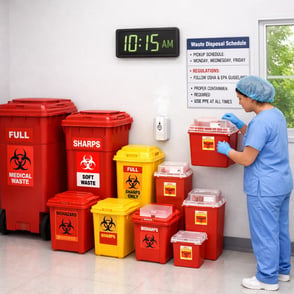
Regulated medical waste (RMW) falls into five distinct categories, each requiring its own container, handling process, and disposal pathway. Color-coded containers exist for a reason — use them.
| Waste Category |
Container Color |
Common Examples |
| Biohazardous / Pathological |
Red Container |
Blood tubing, soaked dressings, suction canisters, isolation waste |
| Sharps |
Sharps -> Red Container |
Needles, scalpels, broken glass/vials, blades, pins, clips |
| Pharmaceutical (Non-Hazardous) |
Blue Container |
Residual meds in syringes/IV bags, expired OTC/Rx drugs |
| Chemotherapy Waste (Trace/RCRA Empty) |
Yellow Container |
Tubing, bags, vials, gloves, gowns, wipes used in chemo |
| Hazardous Pharmaceutical (RCRA) |
Black Container |
RCRA-listed hazardous drugs — requires specific handling |
1. Biohazardous / Pathological Waste (Red Bag)
This is the category most clinical staff are familiar with, but familiarity can breed complacency. Red bag waste includes:
- Blood and other potentially infectious materials (OPIM)
- Blood tubing and soaked or bloody dressings
- Intact glass or plastic bottles containing body fluids
- Disposable items saturated with infectious materials
- Contaminated waste from isolation patients
- Suction canisters or liners with bloody fluids or OPIM
Some states require separation of Biohazardous and Pathological waste for different treatments and some do not. If any question arises, feel free to reach out and we can help.
2. Sharps Waste (Sharps Container -> Red Bag)
This category carries the highest risk of immediate physical harm. Sharps waste includes anything with the ability to puncture human skin:
- Needles, syringes with attached needles, and empty carpujects
- Scalpels, blades, and razors
- Broken glass, vials, and slides
- Pins and clips
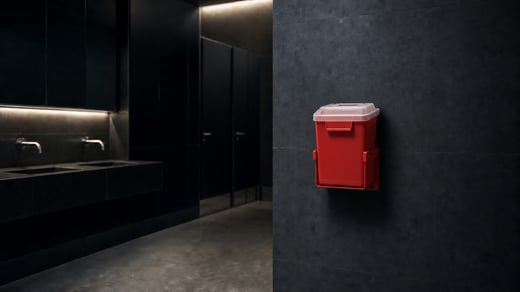
Critical rule: sharps must be placed in a rigid, leak-proof, puncture-proof, closable container before being placed inside any larger biohazard collection container. This step is non-negotiable. It is also one of the most commonly skipped.
From our experience: One of the most frequent mistakes we see is sharps being placed directly into a standard biohazard bag rather than a rigid sharps container first. This is how needle sticks happen — not in dramatic moments, but in routine waste handling.
3. Pharmaceutical Waste — Non-Hazardous (Blue Container)
Blue container pharmaceutical waste covers non-hazardous, non-scheduled narcotic drugs and scheduled narcotic drugs that have been chemically digested. This includes:
- Syringes and tubes with residual medications
- IV bags and tubing with residual medication
- Partially used or expired prescription or OTC medications
Important note: Non-hazardous pharmaceutical waste that is a DEA scheduled drug can be disposed of in blue containers after it has been chemically digested. This distinction matters for compliance.
One of the most persistent myths in clinical practice is that flushing non-controlled substances is acceptable. It is not. Most modern wastewater treatment plants are not designed to remove complex pharmaceuticals. When medications enter the water supply, they affect plant and animal life and contribute to antibiotic resistance. Flushing is not a disposal solution — it is a transfer of the problem. The EPA has explicitly banned the practice of sewering hazardous pharmaceuticals as of August 2019 and strongly discourages the disposal of any pharmaceuticals in the sewer system due to environmental damage and water pollution.
4. Chemotherapy Waste — Trace or RCRA Empty (Yellow Container)
Any supply used to prepare or administer chemotherapy medications belongs here, including trace amounts:
- Tubing, empty bags, bottles, and vials
- Syringes, gloves, pads, masks, and gowns
- Wipes and any other material contaminated during chemo treatment
Note: sharps contaminated with chemotherapy agents are handled separately from standard sharps waste. Do not combine these streams.
5. Hazardous Pharmaceutical Waste / RCRA (Black Container)
RCRA-listed hazardous pharmaceuticals represent the most tightly regulated category. These drugs are classified as hazardous under the Resource Conservation and Recovery Act (RCRA) and must follow EPA hazardous waste disposal protocols. Mishandling this stream carries the highest regulatory penalties of any waste category.
The Hidden Danger Nobody Talks About: Broken Glass
Sharps training tends to focus heavily on needles — and rightly so. But broken glass is a quietly serious hazard that is consistently underestimated in clinical settings. Broken vials, cracked slides, and shattered specimen containers are regularly discarded in regular trash bags where they can pierce the bag and injure EVS staff, maintenance personnel, or anyone else handling waste downstream.
These are individuals who were not present when the glass broke, have no idea what it may have been contaminated with, and had no opportunity to protect themselves. The point of sharps safety is not just protecting the person who used the item — it is protecting every person who touches that waste after you.
Broken vials belong in a rigid sharps container. Full stop. If it can puncture a bag or a glove, treat it like a sharp.
What Happens When Things Go Wrong: Real-World Cases
These are not hypothetical scenarios. They are documented cases from facilities that believed their waste management was "good enough."
Kaiser Permanente (2015): A Kaiser hospital facility was fined nearly $150,000 by OSHA after employees suffered sharps injuries because needles had been placed in a biomedical waste collection box instead of a compliant sharps container. This is precisely the scenario described above — a simple process failure with serious human consequences.
Missouri Podiatry Clinic (2017): Anderson Foot and Ankle Clinic faced $93,074 in fines after OSHA cited them for 11 violations, including potentially exposing employees to infectious materials. Eleven violations. In a small clinic. Fines like this can threaten the viability of a practice.
Target (2018): Target was charged by the California District Attorney for unlawful disposal of medical waste materials and fined $7.4 million. A prior similar case in 2011 resulted in $22.5 million in fines. Scale is not a shield — it is a multiplier.
Kaiser Permanente (Recent): In a more recent action, Kaiser Permanente was fined $49 million for illegally disposing of private medical records, hazardous materials, and medical waste. No organization is too large to face accountability.
Federal penalties are not trivial. EPA violations under RCRA can carry fines up to $75,000 per day per violation. OSHA serious violations can reach $15,625 per citation, with willful violations reaching $156,259. The math adds up fast.
The Two Most Common Mistakes We See (After 8,000 Customers)
Mistake #1: Regular Trash in Regulated Waste Containers
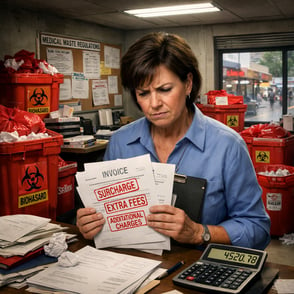
This one works in reverse — staff placing candy wrappers, pop cans, and ordinary trash inside red bag or biohazard containers. This is not a safety violation, but it is a costly one. Regulated medical waste is priced and processed differently from regular trash. When ordinary waste contaminates an RMW container, the entire container must be processed as regulated waste. Over time, this adds up to significant unnecessary cost for the facility.
Train your team: if it did not come in contact with a patient or a biological material, it does not go in the red bag.
Mistake #2: Unsecured Sharps Before Container Placement
As described above, sharps must be secured in a rigid, puncture-proof, closable container before entering any collection or transport container. This is not optional, and it is not a technicality. When this step is skipped, needle sticks happen.
And the consequences of a needle stick are not just a bandage and a tetanus shot. When a sharp has been used in a clinical setting and its contamination history is unknown, the affected employee may face:
- Immediate post-exposure prophylaxis (PEP) treatment
- Long treatment cycles to guard against HIV, Hepatitis B, and Hepatitis C
- Weeks or months of uncertainty while awaiting confirmatory test results
- Long-term monitoring for symptoms and complications
This is not an abstract risk. It is a life-altering experience for the person who gets stuck. Proper sharps containment is one of the most direct things a clinical team can do to protect its own people.
Does Facility Size Change Your Obligations? No.
One pattern we observe across our customer base is that smaller facilities sometimes underestimate the complexity of their waste streams — they assume that because they generate lower volumes, the rules are more lenient. They are not. Every waste generator, regardless of size, is held to the same federal and state standards.
Larger facilities often have dedicated compliance staff, but they face their own challenge: with more employees comes more variability in practice. Having the right waste streams set up is only half the equation. Ensuring that every staff member — on every shift — knows what goes where is the ongoing work.
There is always room for improvement at all facilities, large and small. The difference between facilities that stay compliant and those that face violations is almost always consistency of training and the presence of a trusted disposal partner who flags issues early.
What Good Medical Waste Management Actually Looks Like
Based on our work with thousands of healthcare facilities, here is what a well-functioning waste management program looks like in practice:
- Waste streams are identified accurately at the point of generation — not sorted after the fact.
- Color-coded containers are placed at point of use, not just in a back hallway.
- Sharps are always secured in a rigid container before placement in collection bins.
- Staff are trained not just at onboarding but regularly and repeatedly.
- Collection frequency is calibrated to actual volume — not too often, not too infrequently.
- Documentation and manifests are retained so that the facility can demonstrate a clean chain of custody.
It is not as complicated as it seems. The fundamentals are learnable, and the right disposal partner makes the operational side straightforward.
You Don't Have to Figure This Out Alone
At The Shredder + MedShred, our process starts with a comprehensive needs assessment. We identify your waste types and material categories, evaluate the right container types, sizes, and placement, and build a custom plan around your facility — not a one-size-fits-all program.
We are not one of the large national vendors. We are experienced specialists with 16 years in the field and relationships with more than 8,000 customers who chose a partner that actually knows their operation. Our service is built to flex as your needs change — and we provide full documentation and certification of destruction so you always know your waste was handled correctly.
If you are unsure whether your current waste streams are set up correctly, or if you have been relying on a "good enough" approach, this is a good moment to take a closer look.
Call The Shredder + MedShred for a no-pressure consultation. We will walk through your waste streams with you and tell you exactly where you stand.
Visit us at www.the-shredder.com or call us to speak with someone who has seen what you're dealing with — and helped thousands of facilities fix it.
The Shredder + MedShred has provided regulated medical waste disposal services to healthcare facilities for over 16 years, serving more than 8,000 customers. We specialize in compliant, cost-effective, and personalized secure shredding and regulated medical waste disposal solutions for clinics, hospitals, specialty practices, and more.




Comments