Do I Really Need a Medical Waste Disposal Service?
By Alex Benskin, CEO of The Shredder + MedShred | In business since 2010
If you're running a medical practice, dental office, veterinary clinic, tattoo studio, nursing home, funeral home, surgery center, or any business that generates biological or chemical waste — you've probably asked yourself this question at least once. Maybe you're a new business trying to keep startup costs low. Maybe you've been operating for years and just assumed your current waste handling was "good enough." Or maybe you simply don't generate that much waste and figured it wasn't a big deal.
After more than 15 years in the medical waste industry, I can tell you this: the answer is almost always yes, you do need a professional medical waste disposal service — and the cost of not having one is almost always far greater than the cost of having one.
Let me explain why.
Who Actually Generates Medical Waste?
Before we dive into the "do I need it" question, let's talk about who this actually applies to. The list is longer than most people think:
- Hospitals and surgery centers — the obvious ones
- Doctor's offices and urgent care clinics
- Dental offices — sharps, extracted teeth, bloody gauze, amalgam waste
- Veterinary clinics — sharps, biohazardous materials, pharmaceutical waste
- Nursing homes and assisted living facilities
- Funeral homes — pathological waste and regulated materials
- Tattoo and piercing studios — sharps and potentially infectious materials
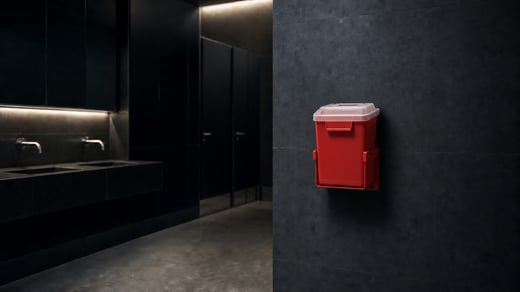
- Large employers — break rooms and restrooms where employees self-inject medications like insulin
That last one surprises a lot of people. If you're a large employer and your workers manage conditions like diabetes on the job, there's a good chance used needles are ending up somewhere in your facility. Where those needles go matters — legally and practically.
The point is: regulated medical waste isn't just a hospital problem. It touches nearly every corner of healthcare, personal services, and even corporate environments.
The Most Common Mistakes We See (And They're Costly)
After 15 years of helping businesses get compliant, the mistakes we see most often aren't the dramatic ones — they're the quiet, everyday errors that accumulate into serious liability. Here are the ones we encounter regularly:
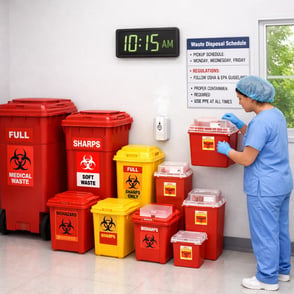
Improperly packaged sharps. Needles, lancets, and other sharps tossed into regular trash bags or non-approved containers. This is one of the most common — and most dangerous — violations we encounter.
Improper waste segregation. This one is more nuanced and gets businesses into trouble more often than they'd expect. Biohazard waste and chemotherapy waste, for example, are not the same thing and cannot be treated the same way. Chemotherapy waste falls under RCRA (Resource Conservation and Recovery Act) regulations and requires specific handling. Similarly, non-hazardous pharmaceutical waste is frequently treated as hazardous — or worse, tossed into red biohazard bags when it shouldn't be there at all.
Putting regular trash into medical waste containers. This one actually costs businesses money. Items that have no biological contamination and could go straight into the regular garbage end up in expensive regulated waste containers, inflating disposal costs unnecessarily.
Flushing medications. New regulations have made this practice illegal or heavily restricted in most jurisdictions. What was once common practice — especially in nursing homes and home health settings — is now a compliance violation.
Accumulating waste with no plan. Just last week, we received a call from a newly opened clinic that had no medical waste disposal plan in place at all. They had been generating regulated waste since opening day with no approved method of disposal. What followed was an urgent scramble to get a service established and accumulated waste removed quickly. It's a stressful, avoidable situation — and it's more common than you might think, especially among new practices.
The Legal Reality: What "Cradle to Grave" Actually Means
Here's a concept that most business owners have never heard of — but should understand before they make any decisions about medical waste disposal: cradle to grave responsibility.
Under federal and state regulations, you — the waste generator — are legally responsible for your regulated medical waste from the moment it is created until the moment it is destroyed. That responsibility does not transfer simply because the waste left your building. If you cannot prove, through proper documentation, that your waste was handled and disposed of by a licensed provider, you can be held responsible for whatever happened to it — including illegal dumping.
That's not a technicality. That's the law.
The EPA's authority over medical waste specifically expired when the Medical Waste Tracking Act of 1988 lapsed in 1991, which means regulation now falls primarily to state environmental and health agencies. Most states have strict requirements — many mandate that accumulated regulated medical waste be disposed of within 30 days. Others set no specific time limit but require continuous proper handling and documentation. Either way, the burden is on the generator.
What this means in practice: if a state or federal agency comes knocking and you cannot produce manifest documentation proving your waste was properly collected, transported, and destroyed by a licensed hauler, you are exposed. Hiring a reputable service like The Shredder + MedShred isn't just convenient — it's your legal proof that you did things right.
The Real Cost of Getting It Wrong
Let's talk numbers, because this is where the "I'll just handle it myself" argument falls apart quickly.
Violations can come from multiple agencies simultaneously — the EPA, OSHA, and your state's Department of Natural Resources or Environmental Protection Agency can each issue separate citations for the same underlying incident.
- EPA RCRA violations for hazardous waste mismanagement can reach up to $75,000 per day, per violation
- OSHA violations under the Bloodborne Pathogens Standard (29 CFR 1910.1030) can run from $16,000 for a serious violation to over $156,000 for willful violations
- DOT fines for improper transportation can reach $79,000 per violation
- State-level penalties vary but commonly range from $1,000 to $50,000 per incident or per day
These aren't hypothetical figures. Real businesses have paid them.
A Rhode Island veterinary clinic was fined $20,000 for disposing of medical waste — including needles — at a landfill, even though the needles were believed to be uncontaminated. The state's position: you can't guarantee it, so you're liable.
A California hospital was fined $149,000 after three employees sustained needle stick injuries because sharps containers were routinely overfilled.
A Pennsylvania dentist received a $100,000 penalty for dumping bags of syringes and other waste into a waterway — waste that later washed up on East Coast beaches.
And it doesn't take egregious behavior to get hit. Fines for seemingly minor violations — mislabeled containers, wrong waste streams, improperly stored materials — can exceed $70,000 per day under RCRA. In many cases, the fine isn't discovered until it's already been accumulating.
Beyond the fines, there are indirect costs: elevated insurance premiums, mandatory retraining programs, third-party audits imposed as part of consent agreements, and in severe cases, criminal charges against facility administrators personally.
The message is simple: the cost of a medical waste disposal service is a fraction of the cost of one violation.
"But I Only Generate a Small Amount of Waste…"
This is the argument we hear most often — and it's the one that leaves businesses most exposed.
My perspective after 15 years in this industry: the volume of waste you generate doesn't change your legal obligations. A dental office generating one small sharps container a month has the same cradle-to-grave responsibility as a hospital generating thousands of pounds of regulated waste a week. The regulations don't have a "small enough to ignore" exemption.
What small volume does mean is that your costs for a professional service will be lower — not that you can skip it altogether.
The risk of going without proper documentation isn't theoretical. If your waste is ever found improperly disposed of — whether by your own mistake or someone else in your building — and you have no manifest records, no licensed hauler documentation, no proof of proper disposal, the assumption is not in your favor. Agencies may conclude the waste was simply thrown in the trash. Or worse.
The peace of mind that comes from having a properly documented, compliant disposal program — from a company that provides you with certified destruction records — is worth more than most businesses realize until they need it.
What the Setup Process Actually Looks Like
One of the biggest reasons businesses avoid getting a service is the assumption that it's complicated. It isn't — at least not when you work with the right partner.
At The Shredder + MedShred, we break it down into four simple steps:
Step 1: Consult. We start with a comprehensive needs assessment. We identify the types of waste your operation generates, evaluate which container types and sizes make sense, determine placement and pickup frequency, and build a complete picture of your compliance requirements. There's no one-size-fits-all approach here.
Step 2: Design. We build a solution around you — not the other way around. This means a custom plan tailored to your actual needs, recommendations that can save you money (yes, many businesses are over-spending on waste disposal with containers they don't need), your choice of equipment, transparent pricing, and the flexibility to adjust as your business grows or changes.
Step 3: Implement. Equipment is deployed to your location. We confirm the service is set up exactly as agreed — placement, schedule, documentation protocols — and make sure your team knows what to expect and when.
Step 4: Service in Motion. From here, it's a simple, repeating cycle: you fill the equipment on your schedule, we collect, document, transport, and certify the destruction of all regulated waste, then we monitor and adjust to your needs over time. You receive certified documentation for every single pickup — your proof of proper disposal.
That's it. For most businesses, the hardest part is making the first call.
Why Local Beats National — Every Time
Here's something worth knowing before you sign anything: the largest national medical waste disposal companies have a significant brand recognition advantage. You've probably heard of them. But brand recognition and quality of service are not the same thing.
The business model of large national providers is built around enterprise-scale accounts — hospital networks with dozens of locations, national healthcare chains, large institutional clients. When you're a single dental office, a veterinary clinic, or a tattoo studio, you are not their priority customer. You are a number in a very large system.
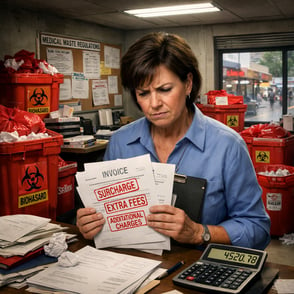
The customer service record of these national providers speaks for itself. Customers describe missed pickups that go unresolved for weeks or months, billing errors that take months to correct, and customer service routed through offshore call centers where nothing ever gets resolved. Some businesses report waiting on callbacks for two business days, then never receiving them at all. Others describe fighting for months just to cancel service they were never even receiving.
At The Shredder + MedShred, our position is simple: we are big enough to do it right, and small enough to care.
When you call us, you reach someone who will own your request until it is resolved — not a call center, not a case number that sits in a queue. We live, work, and play in the same communities we serve. We're not a global corporation extracting value from local businesses. We are a local business, just like many of our customers. That matters.
We have been doing this since 2010. We handle regulated biohazardous waste, sharps disposal, pathological waste, non-hazardous pharmaceutical waste, and chemotherapy waste (RCRA-regulated). We serve hospitals, doctor's offices, surgery centers, dental clinics, nursing homes, funeral homes, veterinary clinics, tattoo studios, and large employers with sharps programs for employees who self-inject. If it's regulated waste, we handle it — with full documentation, every time.
The Bottom Line
If you generate regulated medical waste — even a small amount — you need a professional disposal service. Not because it's complicated. Not because it's expensive. But because the alternative exposes you to liability that could end your business, because the law requires documented cradle-to-grave responsibility, and because the right service makes compliance genuinely simple.
You don't have to go with the national name everyone has heard of. You have options — and those options include a local partner who answers the phone, knows your name, and is as invested in your compliance as you are.
Ready to get set up the right way? Visit us at www.the-shredder.com or give us a call. The consultation is free, the process is simple, and the peace of mind is worth every penny.
The Shredder + MedShred has been providing compliant medical waste disposal services since 2010. For state-specific regulations, we recommend contacting your state's Department of Natural Resources or visiting epa.gov for federal guidance.




Comments