Is Professional Shredding Worth the Cost?
Document Security & Compliance | By Alex Benskin, CEO + President at The Shredder + MedShred
It's one of the most common conversations we have with small business owners: "We don't generate enough material to justify a shredding service." Or: "We just do it ourselves." Or: "We pile everything up and do a big shred once or twice a year."
We get it. When you're running a lean operation, every line item gets scrutinized. But professional shredding is one of those costs that looks expensive on the surface — until you do the math and look at what's actually at stake.
The short answer: yes, professional shredding is worth it. And for most small to mid-market businesses, it's almost certainly cheaper than what you're doing now.
The In-House Shredding Illusion
When businesses decide to shred in-house, the math feels simple: buy a shredder, have someone run it when the pile gets big enough. Done.
But the true cost is rarely that simple. Consider what in-house shredding actually involves over a three-year period — the expected lifespan of a mid-range office shredder:
| Cost Factor |
In-House Shredding |
Professional Service |
| Equipment purchase |
$500 |
$0 |
| Employee time (est. 2.5 hrs/month at $25/hr) |
$62.50/month |
$0 |
| 3-year total cost |
$2,750 |
$1,755 |
| Savings with professional service |
~$995 over 3 years |
|
And that's just the financial cost. It doesn't account for the security gaps that come with in-house shredding: the potential for employee misuse or negligence, the fact that standard office shredders produce strips that can be reconstructed, and the lack of any certified proof that destruction ever occurred.
❌ The Myth: "In-house shredding is cheaper and more convenient."
✅ The Reality: When you factor in equipment, employee time, and liability exposure, in-house shredding costs more and provides less protection.
The Annual Purge: A More Expensive "Savings"
The other approach we see constantly: businesses hold onto sensitive documents for months — sometimes years — before scheduling a one-time purge. The logic is that batching it all together will be cheaper. In practice, the opposite is true.
"Businesses think they're saving money by waiting. What they're actually doing is paying more per page, giving up valuable office space, and leaving sensitive documents exposed for months or years at a time."
Here's why the purge approach backfires:
- Higher cost per page. One-time purge pricing is significantly higher than the per-page cost of a scheduled recurring service. You pay a premium for the irregular volume and scheduling complexity.
- Unpredictable timing. With a scheduled service, you know exactly when we're showing up. With a purge, you're coordinating calendars, waiting on availability, and often pushing it further out than intended.
- Real estate cost. Boxes of documents stacked in a back office or storage room aren't free. That space has value — whether you're leasing square footage or just losing the ability to use it productively, boxes sitting cost money.
- Compounding risk. Every month those documents sit, the risk window grows. One break-in, one disgruntled employee, one flood — and sensitive client or employee data is suddenly exposed.
A scheduled service solves all of this: documents are destroyed regularly at a lower cost per page, on a predictable schedule, with zero accumulation risk.
The Risk Nobody Talks About Until It's Too Late
Cost aside, there's a more serious conversation to have about what happens when sensitive documents aren't handled correctly — and how long businesses are willing to let that risk sit.
Small businesses are subject to the same strict data privacy regulations as large corporations. HIPAA, FACTA, and GLBA don't have a carve-out for companies under 50 employees. If your business handles personal health information, financial records, or employee data — and virtually every business does — you are legally obligated to ensure its proper destruction.
What's actually at risk: A break-in while documents are stockpiled. A lawsuit that requires you to produce records you thought were gone but weren't. An audit where "we shredded that" isn't an acceptable answer without documentation. The longer sensitive documents sit, the larger the exposure window — and the harder it becomes to prove your business acted responsibly.
There's also a less-obvious legal risk worth understanding: if your business is involved in litigation, documents that haven't been destroyed according to a documented retention policy may be subject to discovery. Documents that were destroyed on schedule, as part of a defensible retention policy, generally cannot be compelled. An ad-hoc annual purge is much harder to defend than a consistent, documented destruction schedule.
The Certificate of Destruction: Your Paper Trail of Due Diligence
When we destroy your documents, you receive a Certificate of Destruction. For many small business owners, this is something they've never heard of — or haven't thought to ask for. It matters more than most people realize.
If a data breach ever occurs, or if your business is audited for compliance, saying "we shredded that" won't cut it. A Certificate of Destruction from a certified vendor is documented, defensible proof that your business took the legally required steps to protect sensitive information. It's the difference between demonstrating due diligence and hoping someone takes your word for it.
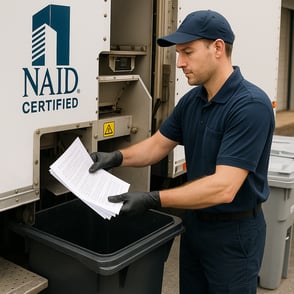
Why NAID AAA Certification matters: Anyone can buy a shredding truck. NAID AAA Certified vendors undergo unannounced third-party audits covering employee background checks, access controls, and even the particle size of shredded material — ensuring documents cannot be reconstructed. A Certificate of Destruction from a NAID AAA Certified vendor proves your business met the industry's highest standard of care.
It's Not Just Paper
One of the most common surprises for small business owners: the range of materials that need secure destruction goes well beyond boxes of old invoices. Materials that require certified destruction include:
- Hard drives & SSDs
- Cell phones & tablets
- Microfiche & film
- ID badges & access cards
- Uniforms & branded apparel
- Blueprints & schematics
- Trade secret documents
- Defective manufactured products
- Proprietary work product
- X-rays & medical records
Consider what's at stake beyond a data breach. A manufacturer that discards defective products in a standard dumpster risks those items resurfacing on Facebook Marketplace or eBay — inferior-quality goods carrying your brand, tarnishing your reputation with customers who don't know the backstory. A business with proprietary processes or trade secrets (think: your version of the Coca-Cola formula) that discards documents carelessly is handing that intellectual property to whoever goes through the trash.
Secure destruction isn't just a compliance checkbox. It's a business protection strategy.
A Typical Scenario: The Real Cost of Waiting
Composite scenario based on common customer situations.
A 12-person professional services firm has been managing document destruction in-house for three years. They run an office shredder a few times a month when the pile gets large enough, and periodically schedule a purge for the overflow boxes stacked in a back storage room.
When they reach out for a quote on a purge, the volume is substantial — and the one-time pricing reflects it. After reviewing the numbers, they realize their per-page cost for the purge is significantly higher than what a monthly scheduled service would have cost over the same period. The storage room they've been sacrificing for document boxes frees up. Their team stops spending hours at the shredder. And going forward, every destruction event is documented, scheduled, and certified — building a compliance record rather than relying on memory.
The switch wasn't complicated. It was just math they hadn't done yet.
So, Is Professional Shredding Worth It?
For the vast majority of small and mid-market businesses: yes — unequivocally. The real question isn't whether you can afford professional shredding. It's whether you can afford the alternative plus its probably cheaper than what you're doing now and you may not even realize it.
- The cost of in-house shredding — equipment, employee time, replacement — exceeds a professional service over a 3-year horizon.
- Annual purges cost more per page than scheduled service, consume valuable office space, and create months-long windows of risk.
- Compliance with HIPAA, FACTA, and GLBA applies to your business regardless of size — and requires documented proof of destruction, not just good intentions.
- A NAID AAA Certified vendor gives you a defensible compliance record that protects your business if a breach or audit ever occurs.
- Scheduled service is predictable, consistent, and builds a documented retention policy — something an ad-hoc purge can never replicate.
If your business regularly handles sensitive information — employee records, client data, financial documents, health information, or proprietary materials — a scheduled professional destruction service is almost certainly the more cost-effective, lower-risk, and more defensible choice.
Ready to find out what it actually costs? Get a straightforward quote for scheduled service or a one-time purge — no pressure, just numbers that might surprise you.
Contact Us Today





Comments